Look at this map for a moment.
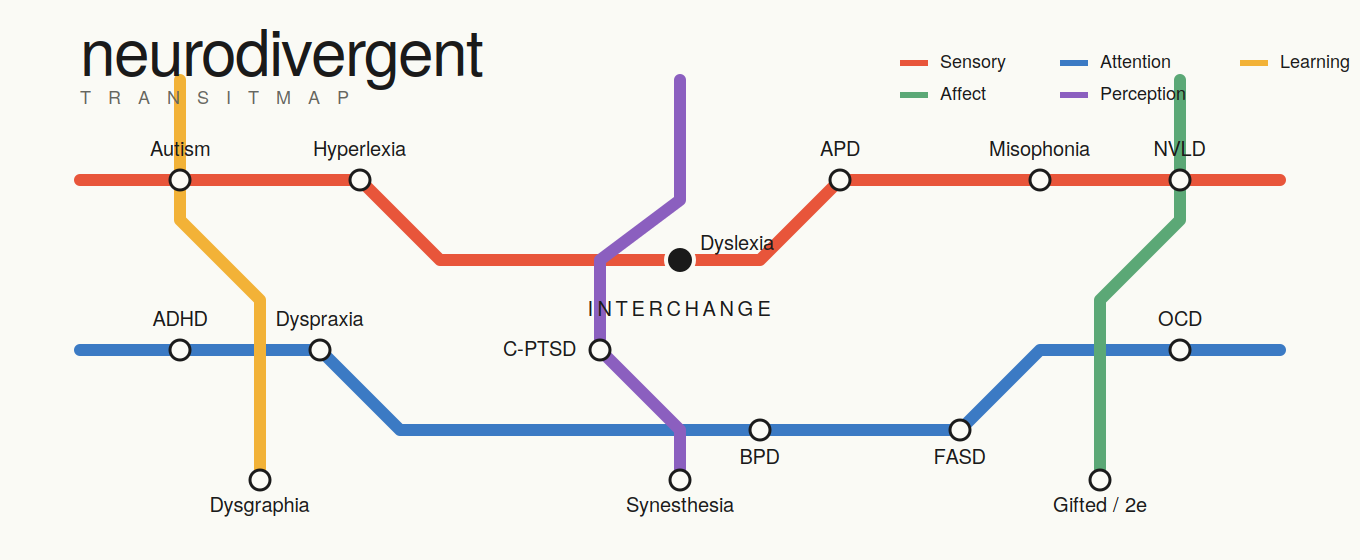
The person at the ADHD stop and the person at the Synesthesia stop are living completely different lives. The one with Misophonia and the one with Dyslexia have almost nothing in common in their day-to-day experience of being alive. OCD and Hyperlexia are not variations on a theme. Gifted/2e and C-PTSD are not two flavours of the same thing.
And yet here they all are. On the same map. In the same community. Under the same broad, imperfect, genuinely useful word: neurodivergent.
I want to sit with that for a moment. Because I think the diversity inside the neurodiversity community is one of the most interesting things about it - and one of the most underappreciated.
How Different We Actually Are
Start with ADHD. The classic experience: time moves strangely, motivation is wired to interest not importance, the hyperfocus hits without warning and disappears the same way. Executive function requires enormous effort for tasks that look trivial from the outside. The emotion regulation piece - the way feelings arrive at full volume - is real and rarely discussed enough.
Now take Synesthesia. Letters have colors. Music has texture. Numbers occupy positions in space. This isn't a difficulty - it's an additional sensory layer, a richer signal than most people receive. The challenges, where they exist, are subtle: distraction from the extra input, occasional overwhelm, the strangeness of explaining it to people who experience none of it.
These are not similar experiences. At all.
Or take Misophonia - the experience of specific sounds triggering intense, involuntary distress. A jaw chewing. A pen clicking. A sound that other people don't even register lands like a physical intrusion. The nervous system responds before the mind can intervene. It's not sensitivity in the colloquial sense. It's a hardwired alarm that can't be switched off.
Compare that to Dyslexia - the experience of text that doesn't quite resolve the way it should, of working harder than peers to decode something that looks effortless from the outside, and often alongside it, spatial intelligence that thinks in three dimensions and narrative reasoning that operates at a level the reading struggle completely conceals.
Or OCD - a mind that cannot stop generating possibilities, checking, re-checking, that turns ordinary uncertainty into a loop that demands resolution and then demands it again. Exhausting, precise, and accompanied by an analytical rigour that is genuinely remarkable when it has the right problem to work on.
These are different instruments. Playing in different registers. On different stages. The experiences they produce, day to day, have little overlap.
The Lines
The map organizes this diversity into cognitive lines - the systems the brain uses to take in, process, and act on the world. Sensory processing. Attention and regulation. Learning pathways. Affect. Perception.
Conditions on the same line often share underlying architecture. Autism and Misophonia and APD all run along the sensory line - different stops, but the same infrastructure of how the brain handles incoming signal. ADHD and OCD and C-PTSD share the attention and regulation line - different presentations, but the same underlying question of how the brain directs and controls itself.
Conditions on different lines share very little. An ADHD brain and a dyslexic brain are not the same kind of different. A person with Synesthesia and a person with Dysgraphia have diverged in completely separate directions from the neurotypical centre.
Which raises the real question. If we're all this different - if our challenges don't overlap, if our strengths don't overlap, if our daily experience of being in a brain is barely comparable - what actually connects us?
The Real Interchange
On the map, the interchange at Dyslexia is where cognitive lines cross - sensory, attention, perception, all passing through the same station. It's a useful way to understand co-occurring conditions.
But there's another interchange that doesn't appear on the map. A social one.
Every person on this map grew up in a world that wasn't built for how their brain works. The school system was built for a neurotypical throughline. So was the workplace. So was the social script - the unspoken expectations about attention spans, sensory tolerances, learning speeds, communication styles, emotional regulation, and what counts as trying hard enough.
The specific stop doesn't matter. The experience of arriving at a station and finding that it wasn't designed with you in mind - that experience is shared across every line on the map.
That's the actual thing we have in common. Not the same brain. The same relationship to a world that assumed a particular kind of brain and then called deviation from it a deficit.
The Idea That Connects Us
Neurodiversity is not a diagnosis. It's a framework - and a surprisingly radical one, when you think about what it actually claims.
It claims that brain variation is real. That it's diverse. That it has value. That the variation itself - not just the challenges it creates, but the genuine cognitive differences it produces - deserves recognition, not just accommodation.
That claim belongs equally to the dyslexic person who reads slowly and thinks in three dimensions, and to the person with OCD whose mind is relentless and precise. To the autistic person who sees patterns others miss and the ADHD person who hyperfocuses brilliantly. To the person with synesthesia who hears music in color and the person with APD who hears sound without being able to filter meaning from it.
The conditions don't share a root. The idea shares a root.
And that idea - that your brain's divergence from typical is not simply a list of deficits, but a real variation with real value - is genuinely new. Historically new. Culturally new. Most of the people on this map grew up before this idea existed in accessible language. Many spent years, sometimes decades, collecting explanations for themselves that boiled down to: you're not trying hard enough, or you're being dramatic, or there's something wrong with you that we can't quite name.
Neurodiversity named it. Differently for each condition, but named it.
Why Community Across Lines Works
Here's something I find genuinely moving about this community: the recognition that crosses lines.
A dyslexic person reads about ADHD time blindness and something clicks - not because they experience it, but because the structure of it is familiar. The feeling of being in your own relationship with time, disconnected from the shared clock everyone else seems to operate on, resonates even across different causes.
An autistic person reads about Rejection Sensitive Dysphoria and recognizes something they know from a different angle. A person with misophonia discovers there's a name for what happens to them in restaurants, and then discovers a community, and finds that the relief of being recognized - finally, accurately named - is itself a shared feeling across every single stop on this map.
The community works not because we all experience the same things. It works because we all know what it's like to be at a stop the rest of the world doesn't recognize. And because hearing how someone else's brain works - even when it's nothing like yours - is a reminder that the standard was never the only option. That the range of what a human brain can be is genuinely vast. And that the variation you carry, whatever line it runs on, is not an error in the code.
You're not here because you're like everyone else on this map.
You're here because you're on it. That's enough.